
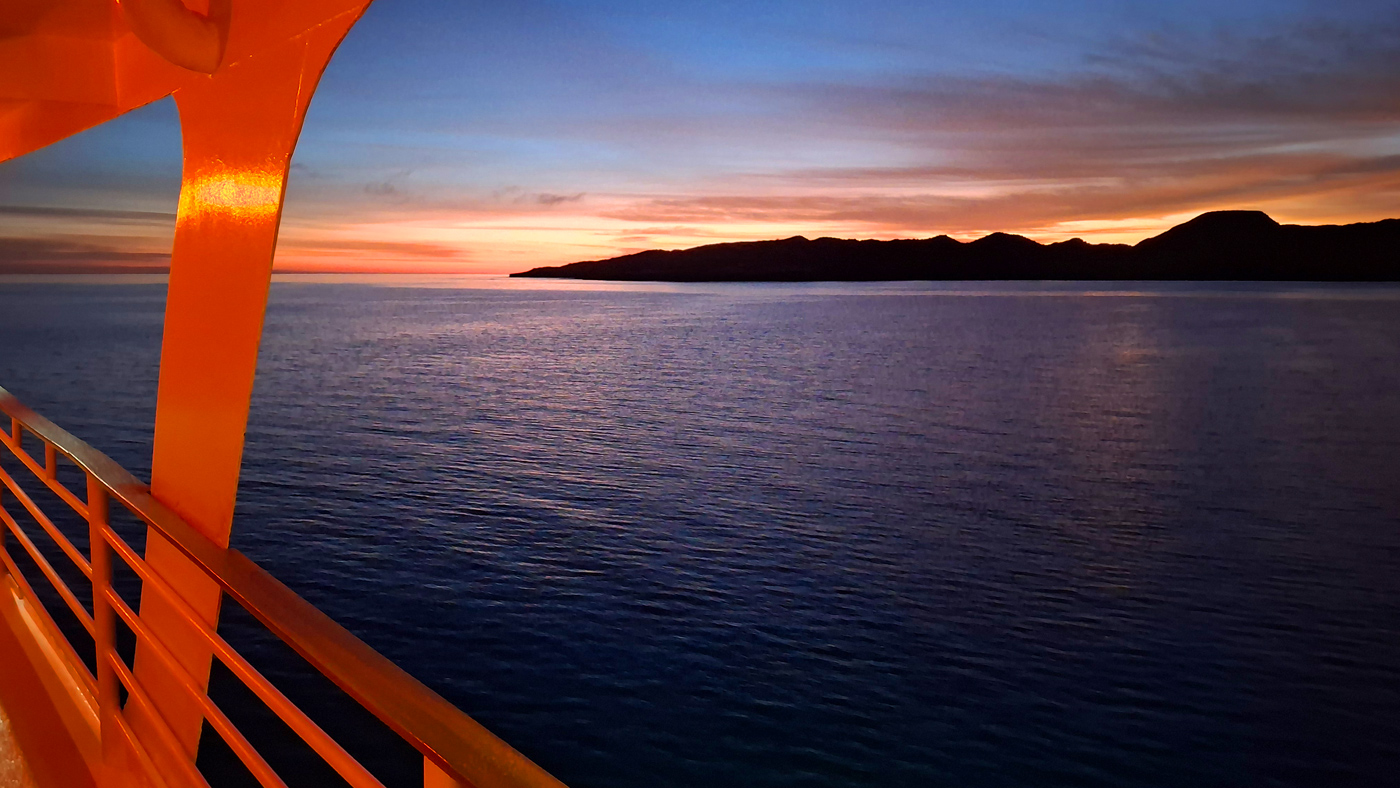
Isla Monserrat (Tuesday):
The yellow stones of Yellowstone
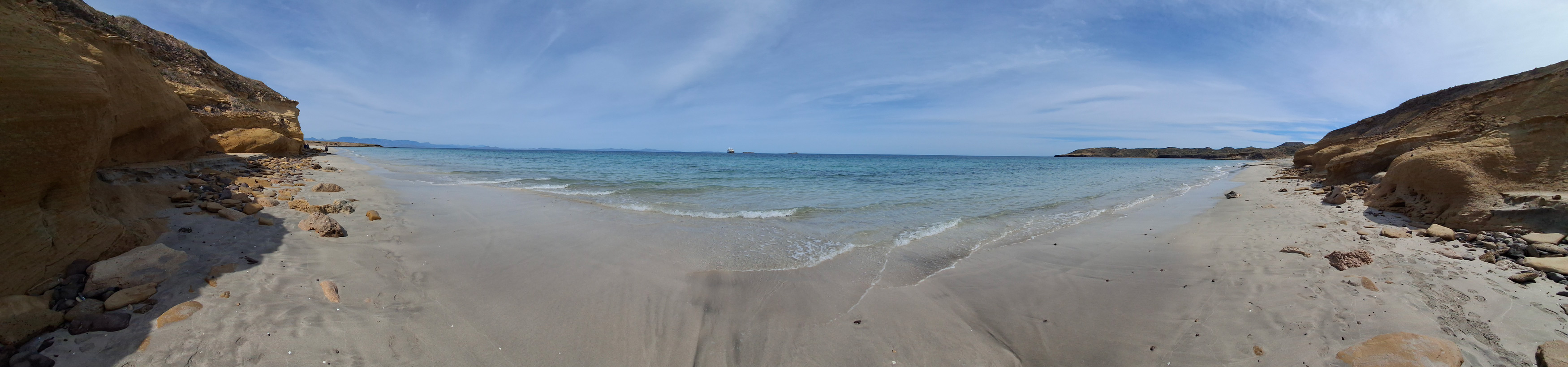
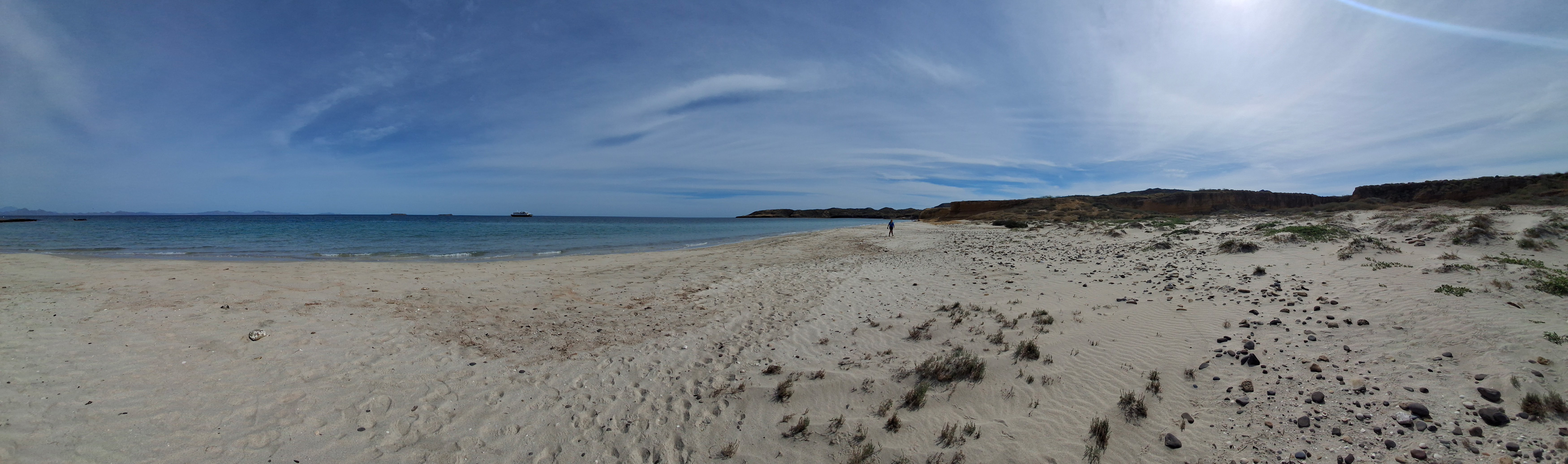
This morning, we both seem to have finally recovered from the week before, and are up in time for Early Riser Breakfast in the lounge, as well as full morning stretches on Aft 400, the sun just barely popping up over the horizon as we sit looking out at Yellowstone Beach.
The beach got it’s name from the yellow-orangish rock present everywhere in remarkable, billowy striations along the coast, particularly when the sun is just hitting the crust.
Regular breakfast in the dining room is French Toast with Bananas Foster. Vacation calories don’t count. Vacation calories don’t count. Vacation calories don’t count.

One with the snorkel
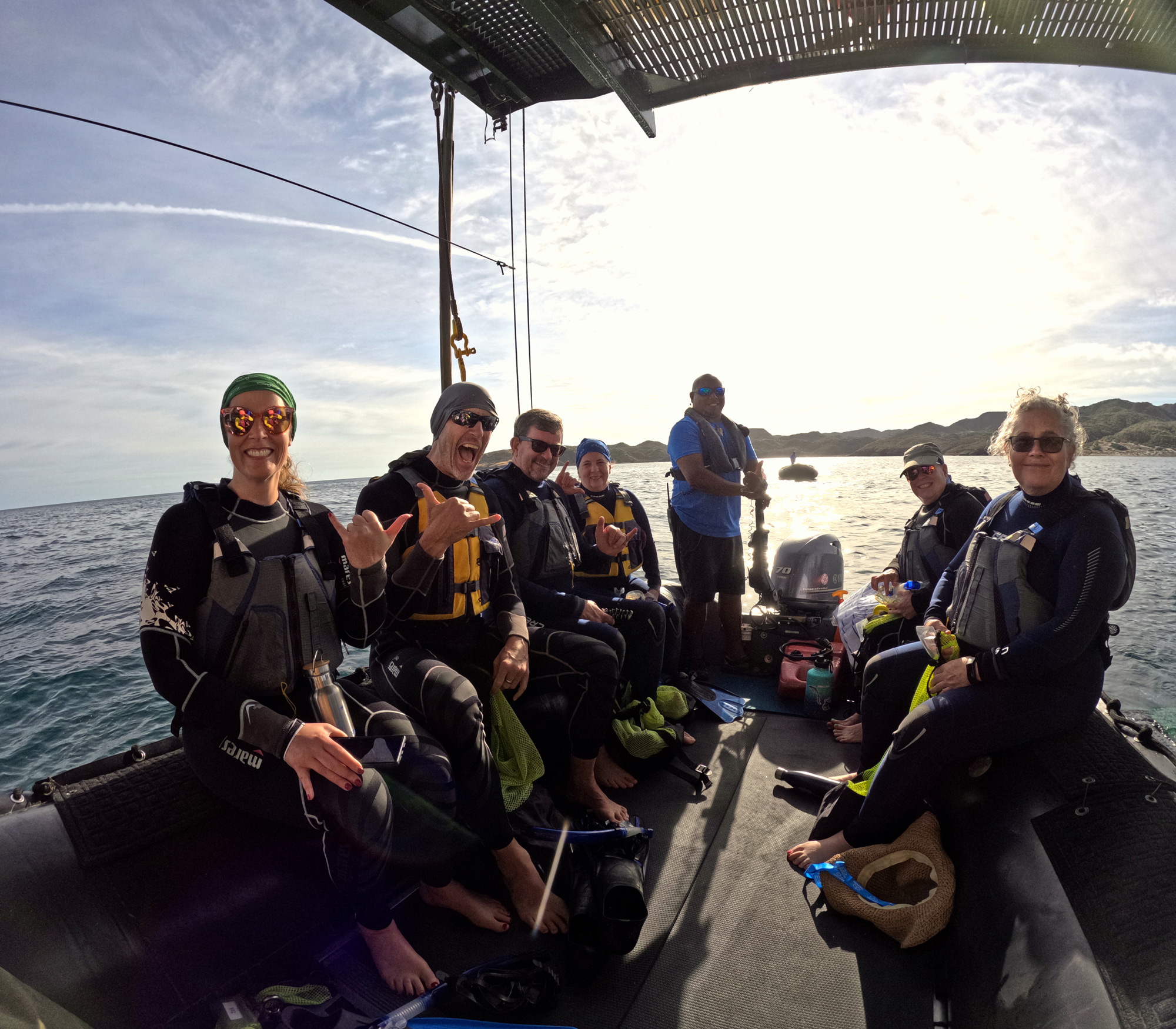
Then it’s an early meet up time for snorkeling. Up on Aft 400, we snake our way into our wetsuits once again, grab our fins and masks, and head down one flight to Aft 300 to join Daniel, who will be leading our expedition. He’s excited, since he’s a former dive instructor, but doesn’t get to lead the snorkeling groups very often. This snorkeling session will be from a skiff, a little different experience than we had from the beach. Daniel tells us the sea will be a bit choppy out around the point where the skiff will drop us off, so he shows us the long red life guard floaty that he’ll always have with him, and tells us he will hold it high out of the water above his head so we can tell where he is. “Stay close. Not too close, but not too far.”
He radios down to the fantail, they are ready for us. A series of viking handshakes and we’re loaded in the skiff, next to the skiff already loaded with arroyo hikers, and the platform lowers us both into the water. The skiff drivers perform a perfect dance to back us away from the boat in tandem, then speed off in different directions, the arroyo hikers to the center of the beach directly ahead of us, and us snorkelers past the point off to the right.
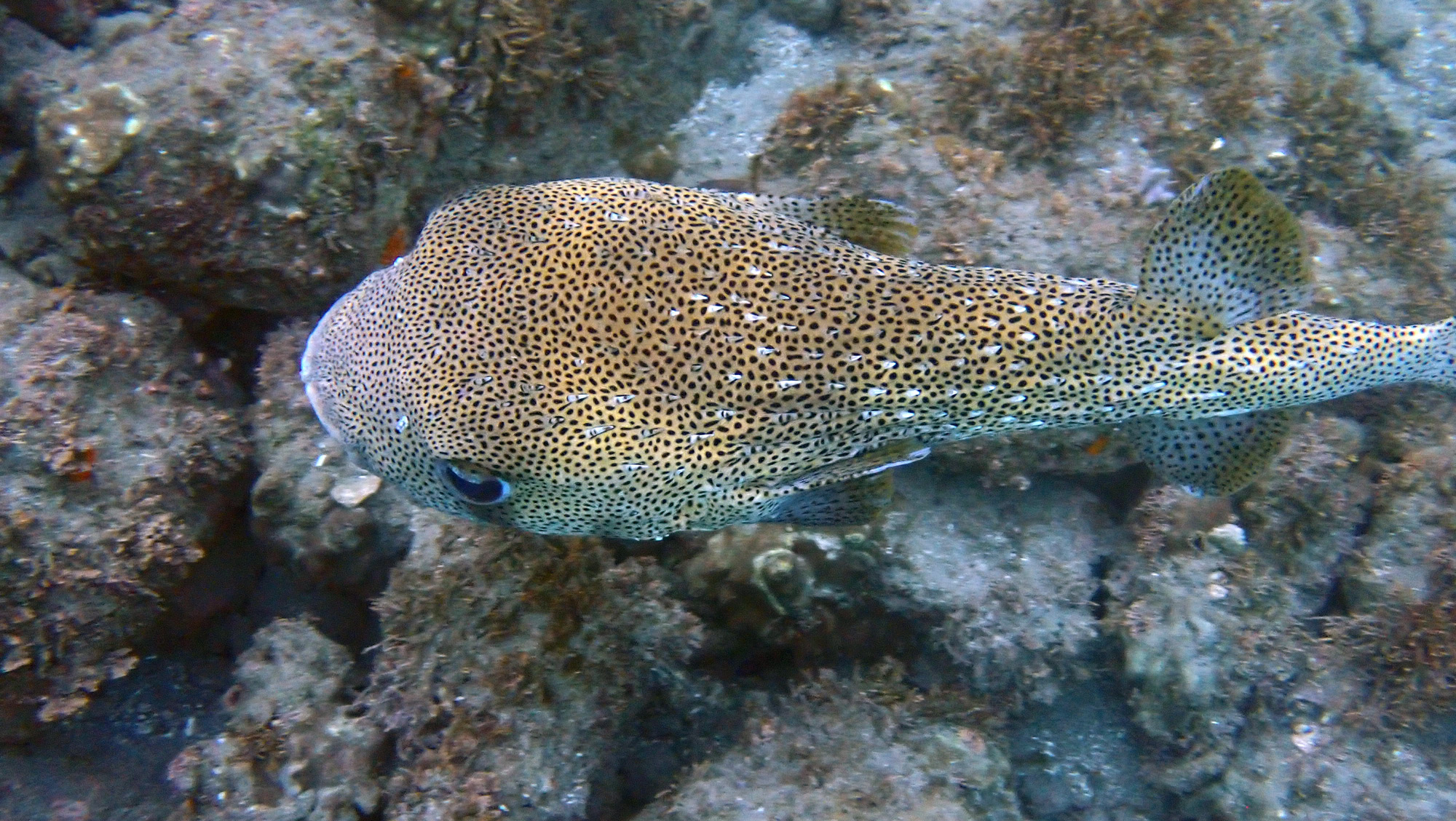
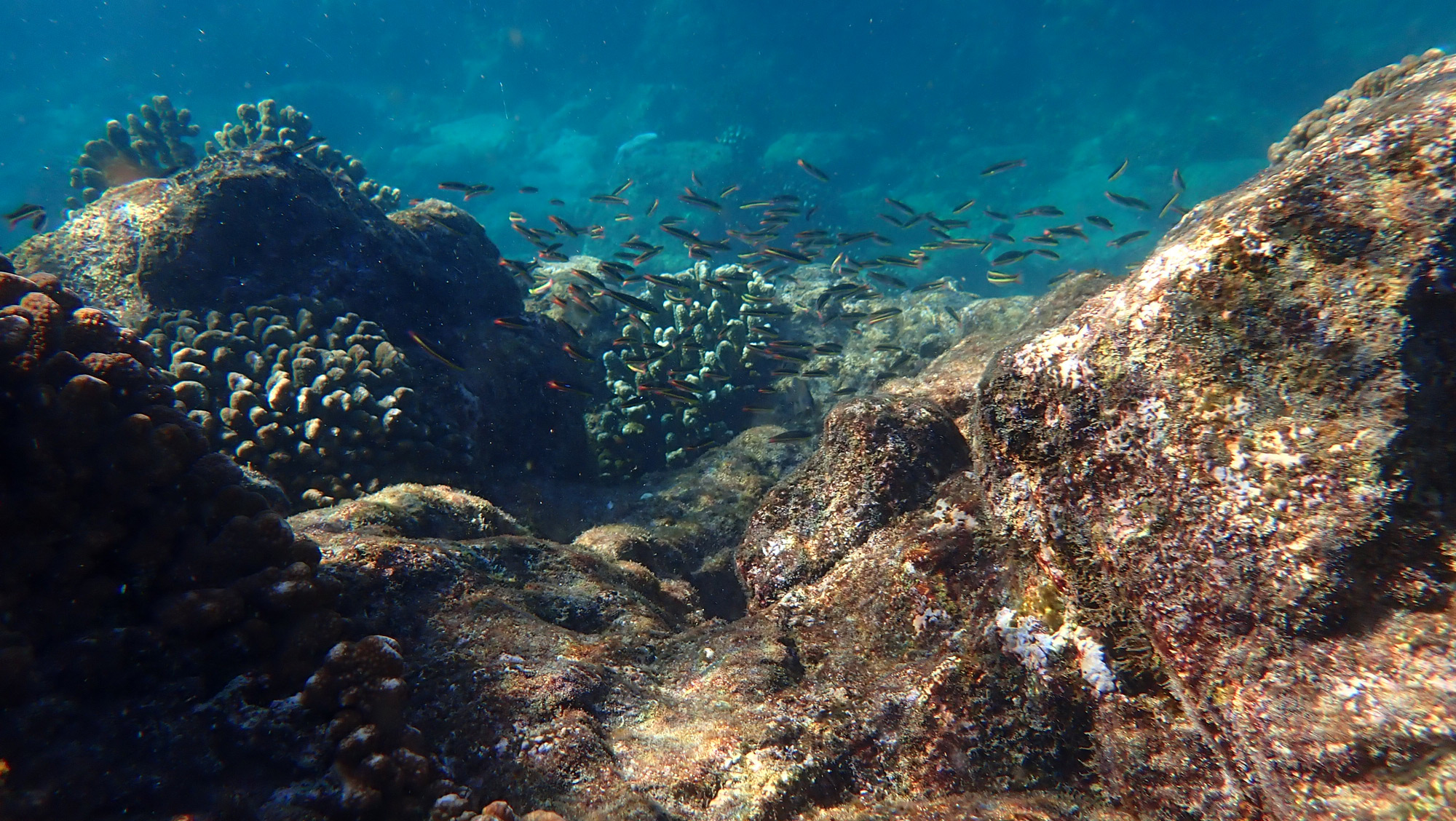
When the skiff is in position, Daniel tells us he has a great idea for a photo. We all swing our legs around and over the inflatable edge of the boat, he counts to tres, and we all simultaneously slip into the water feet first. Uno. Dos. Tres. The chilliness of the water is bracing, with the abrupt entry. We hang out for just a bit for that insulating layer of water to finally begin warming up. At once, it’s pretty obvious things aren’t working quite as well as they did previously. My mask isn’t sealing entirely, and Margy’s snorkel is filling with water. Daniel calmly helps, switching out Margaret’s snorkel for his own, and showing me how to blow water out of my mask without removing it. Eventually things get sorted out enough that we can finally set out exploring, following Daniel’s raised preserver. The coral and rock around the point sit just under the surface in some areas, and you’d have to wait for a swell to get over it. Or you could be following another snorkeler one minute, and suddenly in a dead-end alcove the next. Every once in a while, we could hear Daniel screaming in excitement through his snorkel, as he spots sea life he thinks the rest of us would be interested in. We see a bit of a different complement of fish in this area than we did at Los Gatos. While there were still many pufferfish, there were also many crabs, and huge rockfish just standing on their fins, motionless, on the sandy bottom. There were darker, almost black angelfish, butterfly fish, and surgeonfish, as well as some nudibranch flitting by like dragonkites. Again, surprising how utterly unconcerned they were that these large, black, flailing mammals were invading their space.
Eventually, the skiff lowers a short ladder into the water, and one-by-one we swim over, awkwardly remove our fins, and Daniel gives us a boost into the boat. Once we’re all aboard, the skiff returns us to the Safari Voyager.





The tale of Keen
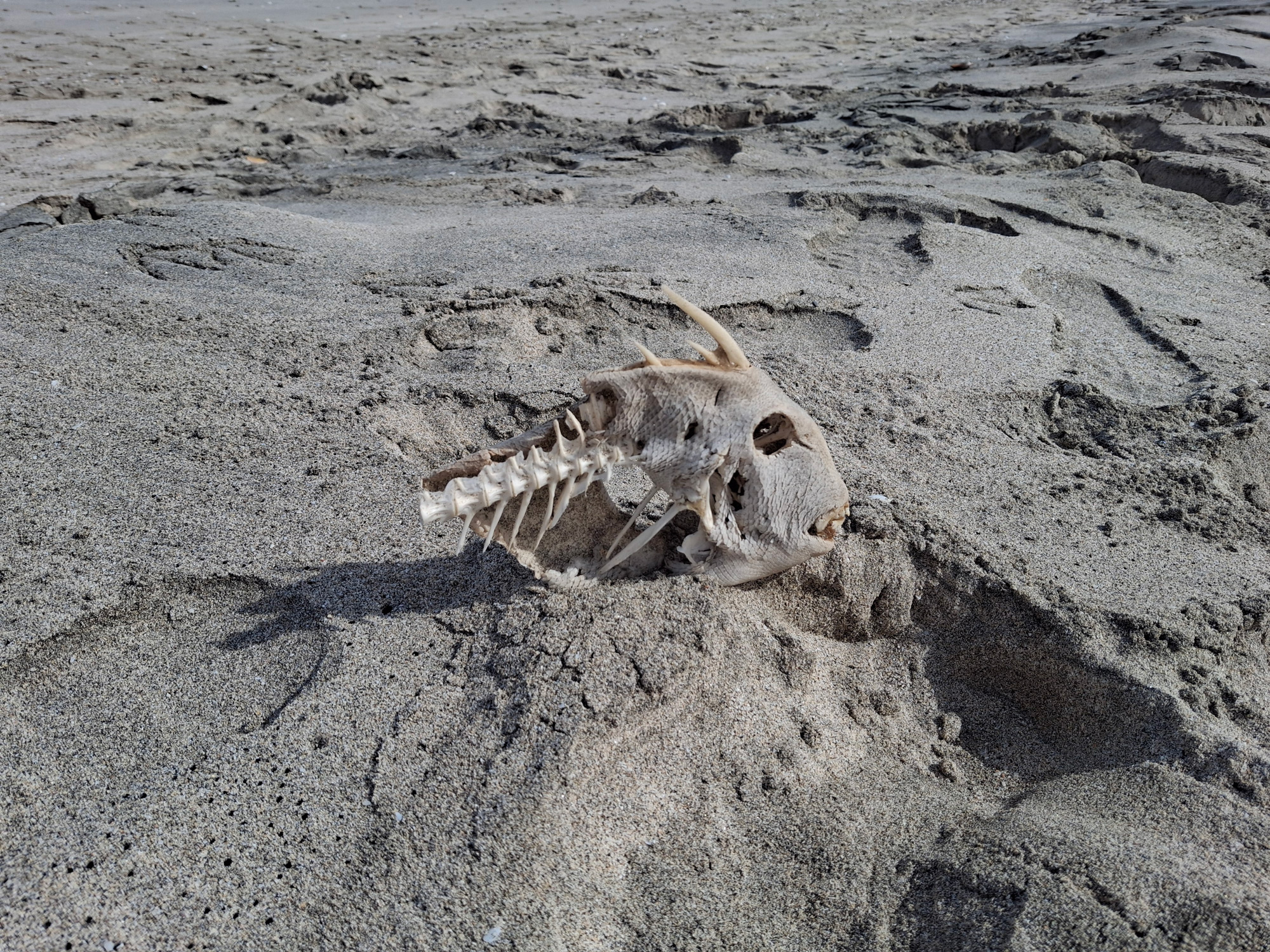
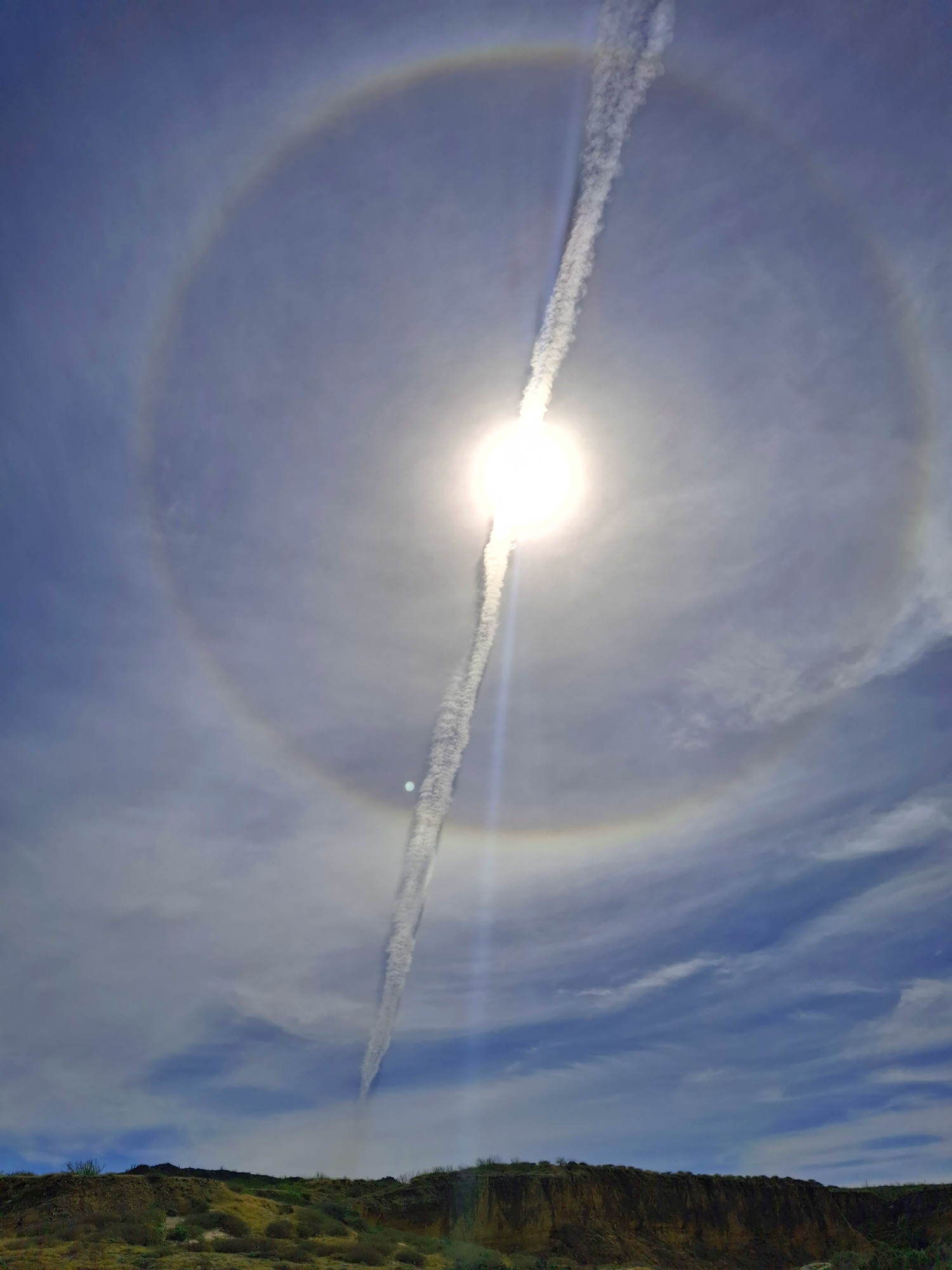
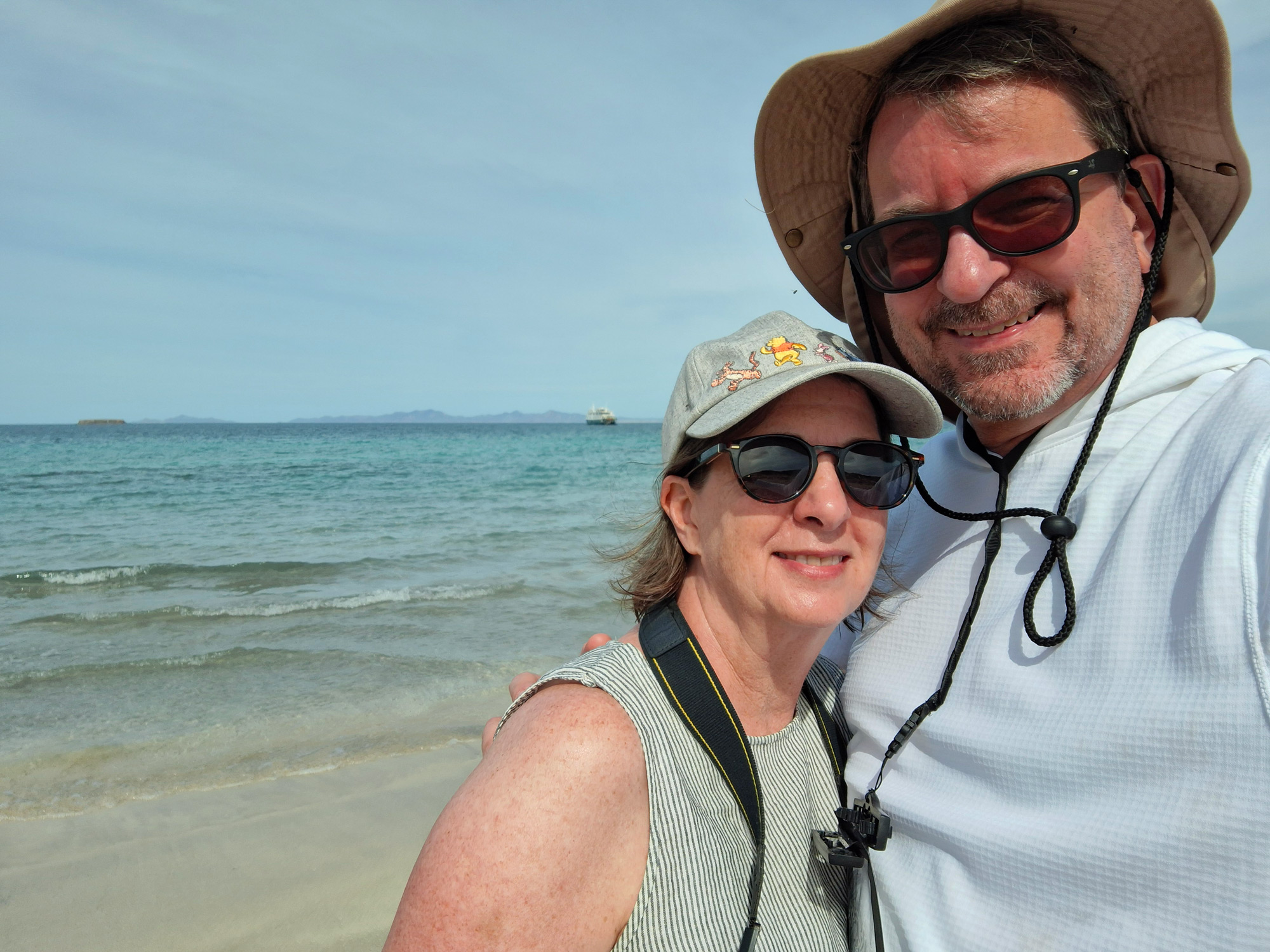
I make my way to the showers at Aft 200, to rinse off sand and salt, and it’s then that I realize that the back straps on both of my old Keen sandals have pulled completely out of the sole. Oh nooooooo! Having a pair of water shoes is pretty essential for nearly any activity off boat, since they require at least one water landing. Without them, my adventures could be severely-limited.
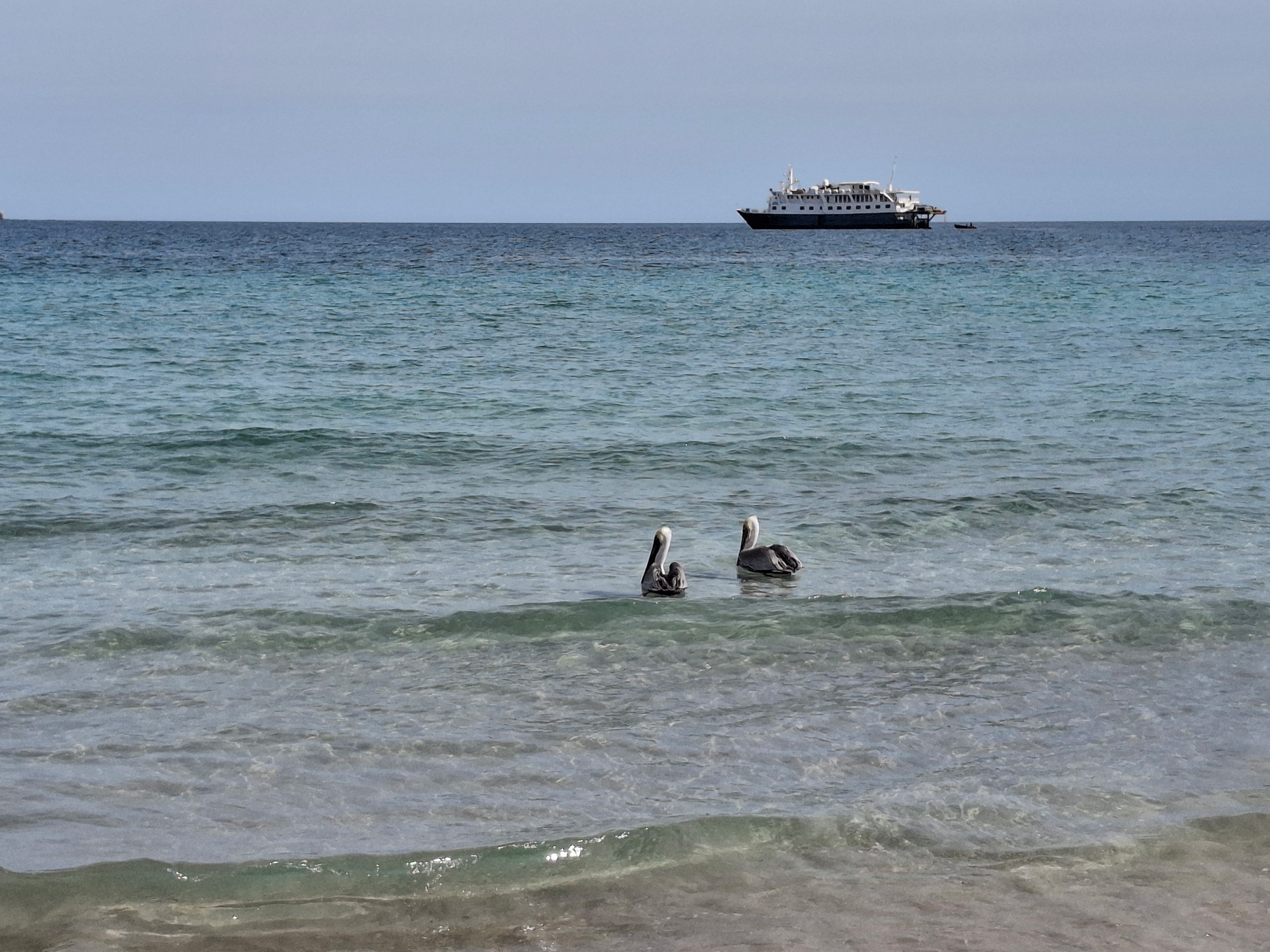
I ask Mereth and Terra if perhaps there are extra shoes in the lost-and-found from previous cruises, or if the onboard “store” might have something. Terra mentions they might have Shoe Goo or ducktape, for a temporary fix, she’ll check this afternoon. Margy and I continue to wash up and dry off, and change out of our wetsuits. There’s still lots of time before the ship leaves anchor, so we decide to catch a skiff back to the beach, so we could get up close to the yellow rocks. I strap my Keen’s on as best I can, pile into the zodiac, and head out. When we arrive at the beach, there are several snorkelers in the water, having a bit of an easier time on this side of the protected point than we were out on the other, unprotected side. We walk the length of the beach.
Returning to the ship for lunch; soft tacos with pork, chicken, fish, and all the fixings. Plus mini cinnamon churros and chocolate sauce. This one desert is the clear differentiator between meals onboard the Safari Voyager, and food at the resort in Cabo. If you remember, Friday night’s Fiesta also featured mini cinnamon churros. They were chewy, but tasty. Perfectly fine if they’re the only churros you’ve ever had. But comparing them to the churros at today’s lunch - delicate, gooey, warm, fresh out of the fryer - just puts them to shame. Again, you forget that all this incredible food is coming out of the 10’x10’ galley. Around the table are MaryLee and Mike & Catherine, talking about all our various animals at home.
Cruising for Critters™
During lunch, the engines of the Safari Voyager are fired up, the anchor is pulled, and we make our way northeast to go looking for whales and whatever else we can find. It doesn't take long, as we're just finishing our meal when there is a call over the loudspeaker:
“Common Dolphins at 1 o’clock!”
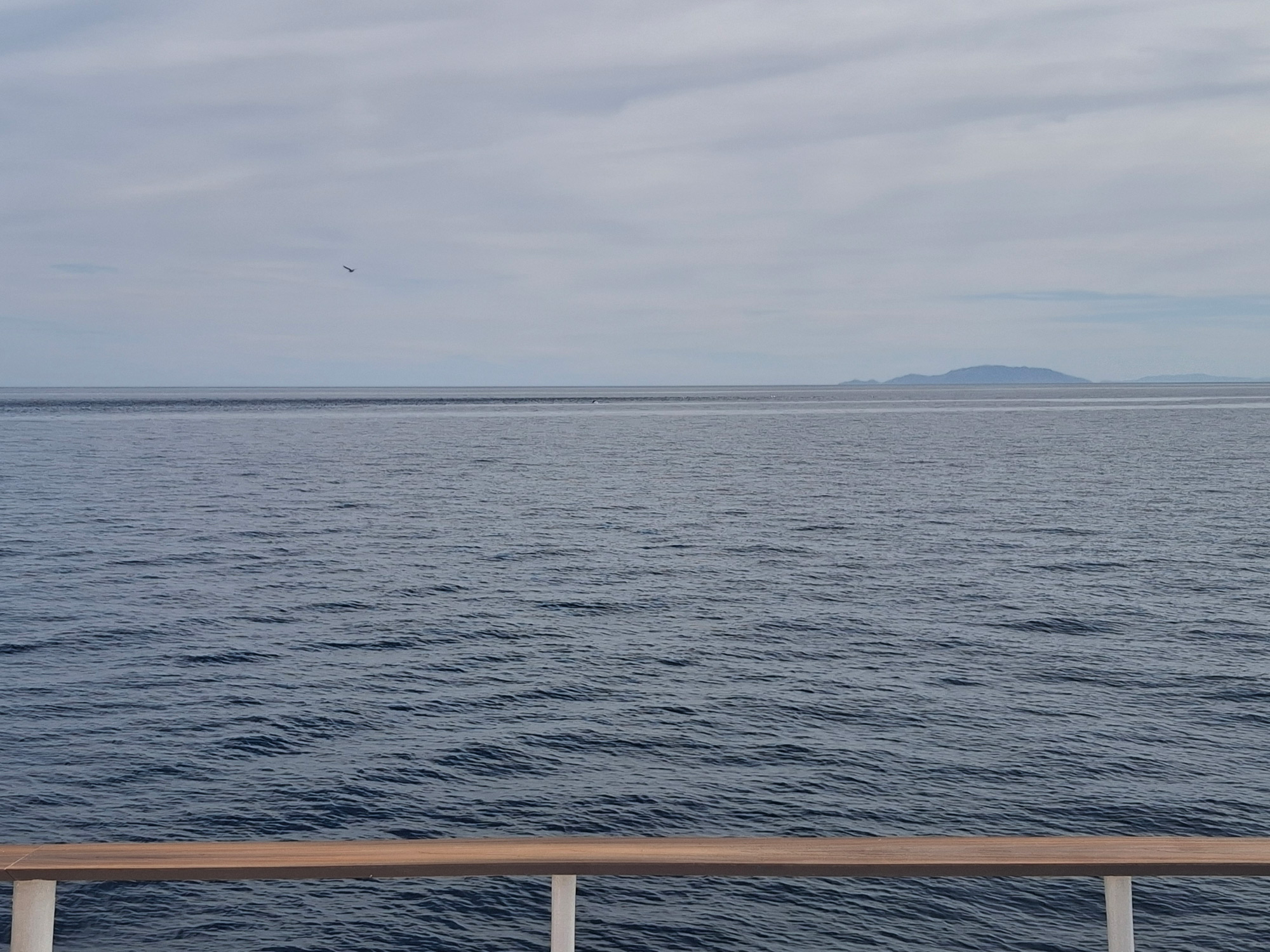
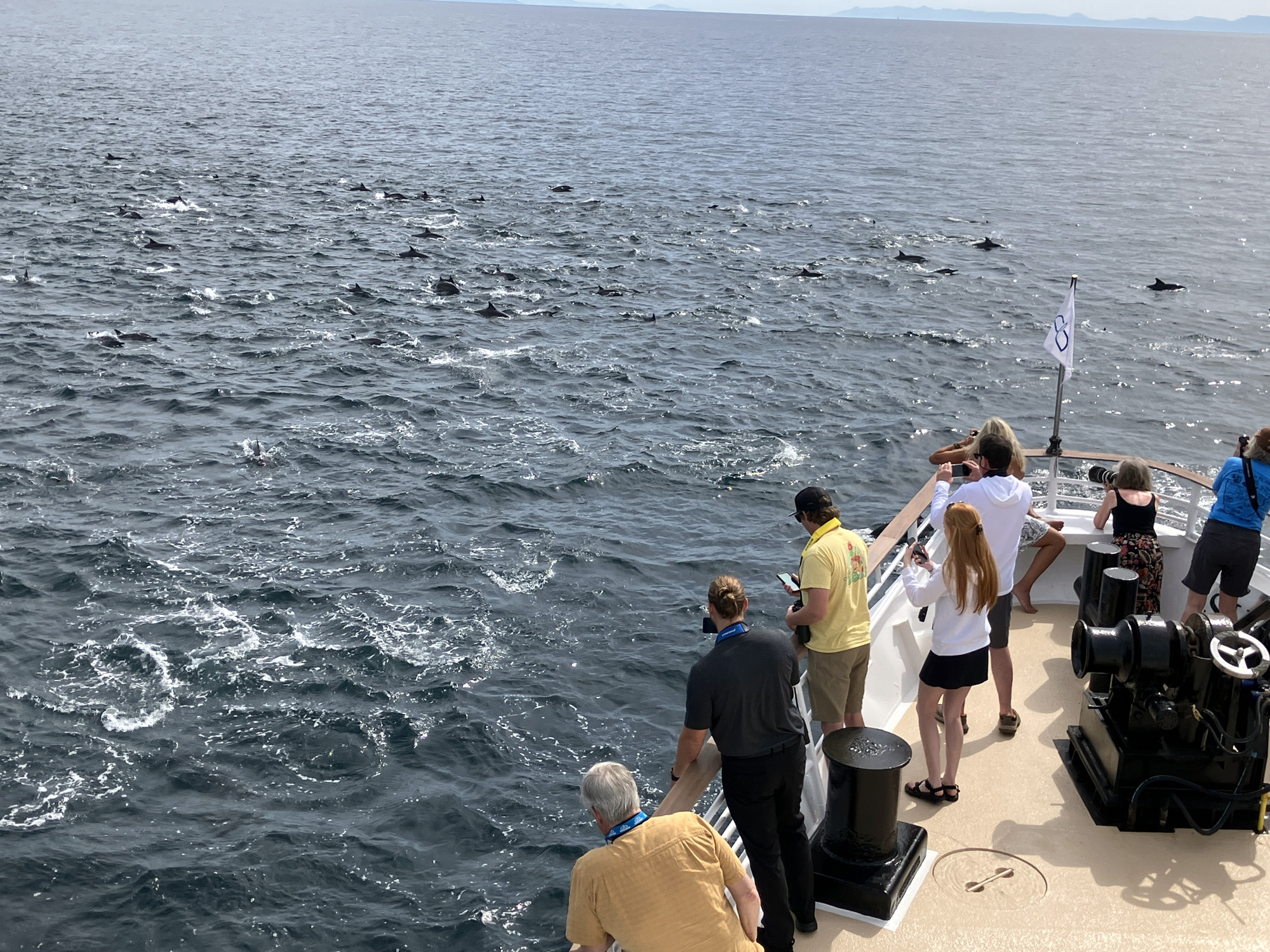
We make our way to the foredeck, binoculars in hand. At first we don’t see any dolphins, all we see is a black line of rocks stretching for a mile, just below the horizon.
“Oh my god, they’ve turned right for us!” says one passenger, pointing.
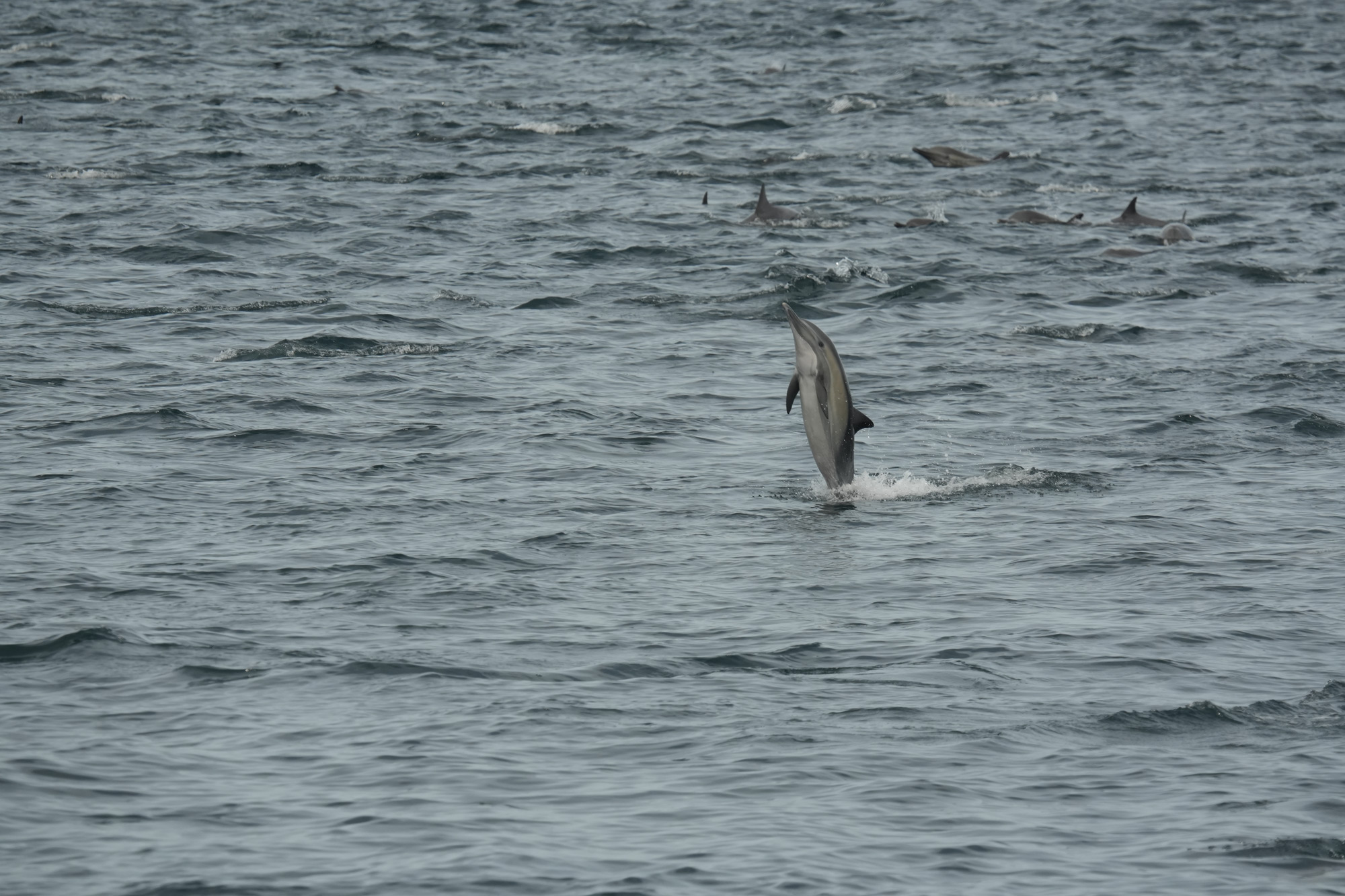
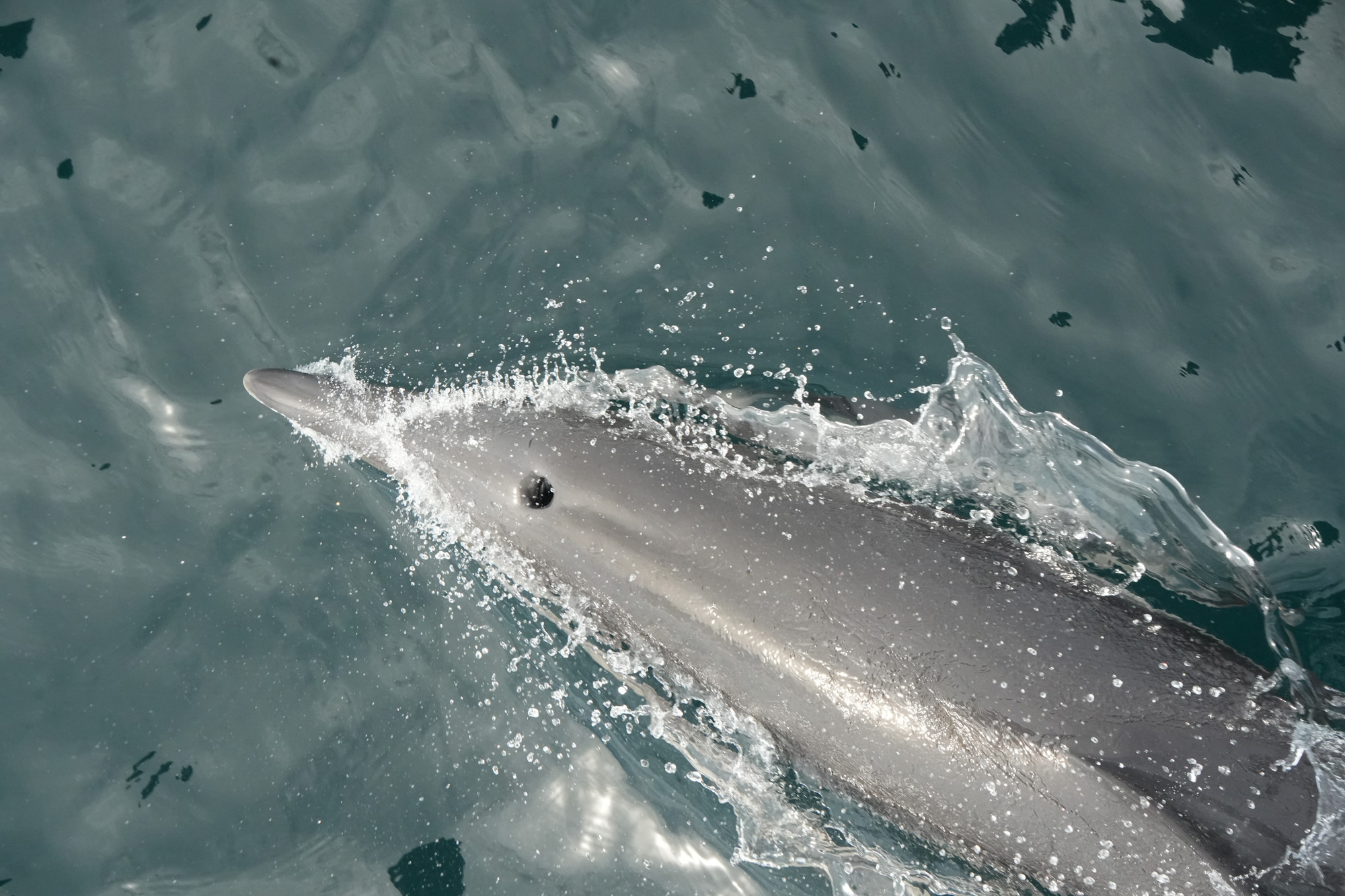
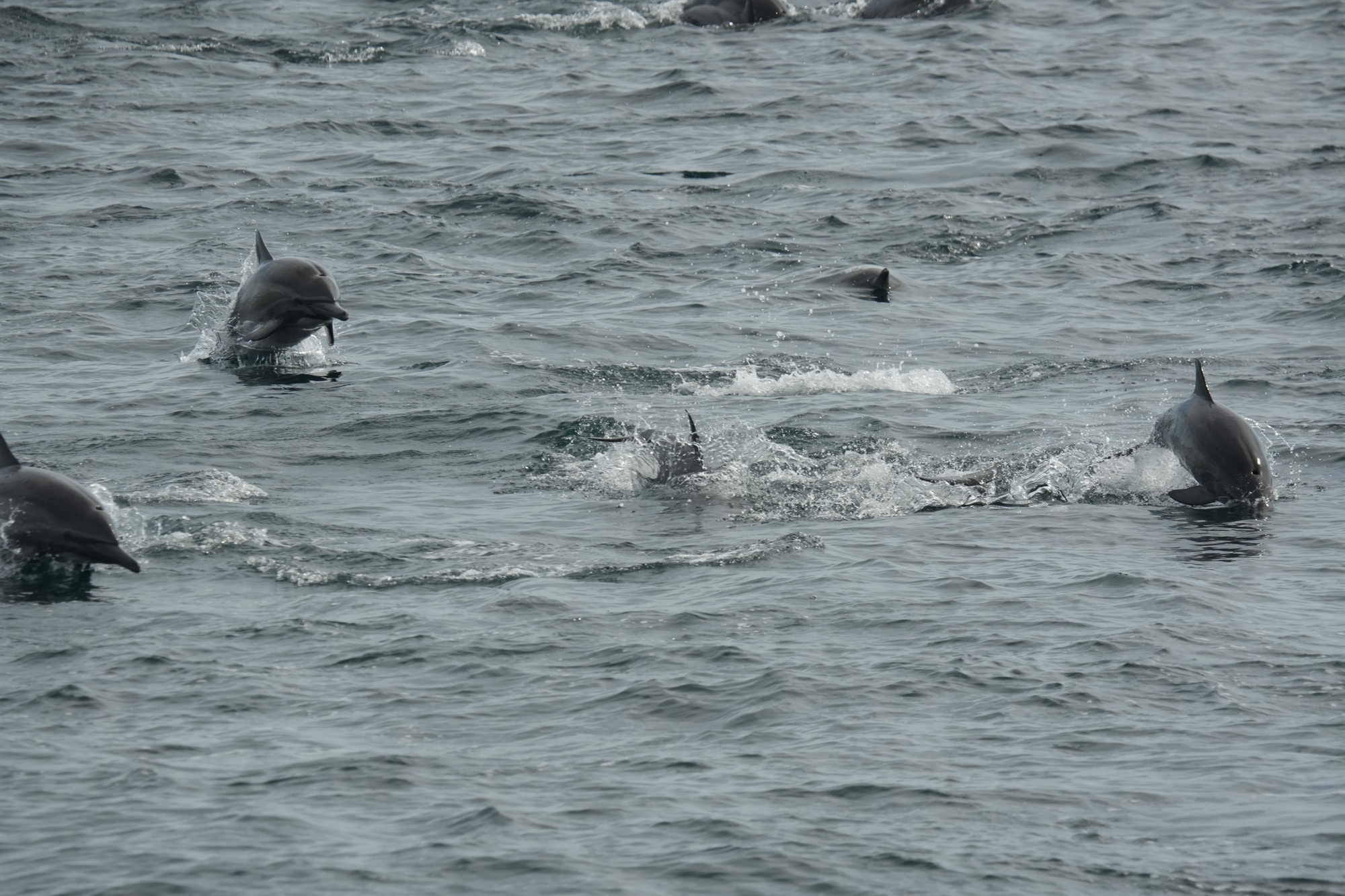
We look closer. The long black line in the sea actually was the dolphins. They are swimming together in a Super Pod, some 500, 600, 800-strong, churning the water like a blender as they leap, ride their tails, and fly in the air. Every one on the ship is either on the foredeck, or up in front of the bridge to try to get the best vantage point. And suddenly, the dolphins are right upon us, swimming around and under the ship, blowing spouts so close they are getting folks standing at the railing wet. Everywhere you look is a dolphin, in a chaotic, almost frantic storm. For almost 10 minutes. And then they were past. Gone. And the water was once again quiet and calm. Someone asks Josh if he’d seen anything like that before, he says “yeeeeaaaahhh, tell you what, if you ever see all of the crew rushing to the bow with their phones and cameras out, you can bet you’re seeing something rare”.
Some 15 minutes later “spout, 12 o’clock!” It takes some time to narrow in, but way off in the distance, we can see the tell tale white spray of a whale against the distant mountains. As the Captain powers up to close the gap, there is suddenly another, “blue whale, 3 o’clock”. The giant whale is passing in the opposite direction, just 50 feet off our starboard, it’s majestic back and dorsal fin breaking the surface every 30 seconds, for almost 15 full minutes. It’s a big male. The Porthole Magazine crew have launched their drone. Terra trains the long lens of her camera on this, the largest animal ever to live on the planet. She says “I think this is his sounding dive, but we won’t see his fluke”. She explains it’s more common with humpback and smaller species, but she has yet to see a blue whale fluke, it just doesn’t happen. Just then, the tail pushes out of the water a full 15-20 feet in the classic whale fluke pose, before curling and arching and disappearing once more. Terra screams in elation. “I was so excited I almost missed the shot!”
“Now, you know what you never see, is a whale breaching!” she states facetiously, hoping her reverse psychology brings the excellent results as before.
Captain radios to track down the spout we saw earlier. It takes a few minutes, but it is now at our 10 o’clock, and quite a bit closer than before. Not only that, but it’s clear there is more than one animal. There are at least two spouts. Once the crew gets a good long look, it’s confirmed; it’s a mama blue whale, with her calf swimming alongside. The drone is once again in the air. We watch them swim north for a good 20 minutes, before Captain breaks off the pursuit. “I’m not seeing any indication that they want to play with us, and I’d rather not put them in any stress” so he turns south to try to track down the roving super pod of dolphins again.
We spot the black line off in the distance, swimming south/southwest. Captain powers up and begins closing in on the pod, Suddenly, we catch just a glimpse of something large slapping the water. What it was, no one is exactly sure, but it causes the dolphin pod to abruptly change course and run, away from us. And they are hauling. “I’ve never seen anything like that before”, Terra says. Captain radios down “I don’t think I’ll be able to catch these dolphins”. He gives it a good chase, but they are just moving too fast. Something spooked them so much that they are literally running for their lives. Captain finally breaks off the chase, and by 4:00pm, we’re officially on our way due south to our next destination, Isla San Jose. We retire to our cabin to review photos and footage.

Puzzle time and the full moon
It’s Happy Hour, and someone has broken out a jigsaw puzzle from the ship’s library. Brooke mixes up a spicy Michelada while we settle in over a game of cribbage (or, cribbage rules as best as we can remember). Sharon & Paul join our table, and look on at our game with puzzlement. We try to explain the rules (or, rules as best we can remember), but Paul is dubious that anything we say is actually a rule. We eventually give up our game (the rules aren’t making much sense to us, either, and even lesso with each sip of our cocktails), and turn to conversation. Everyone is talking about the dolphins, and the Porthole team is showing off the amazing drone video of the whales. It definitely seems like Captain’s idea paid off.
At the 6 O’Clock News, Captain tells us we’re in a very unique position. The planets have aligned, quite literally. The full moon earlier this week means the tide will be high enough for the skiffs to make it into the protected lagoon of mangrove at the northern tip of Isla San Jose, something they’re rarely able to do. He’s also expecting calm seas all night and tomorrow. We’ll spend the morning in and around Isla San Jose, then transit south to Isla San Francisco for the afternoon. Terra fills us in on the day’s activities. With the calm water and high tide, there will be a kayaking and the skiff tour through the mangrove. There will also be an eco meander around the beach. For the afternoon in Isla San Francisco, there will be a moderate hike along the ridgeline, and a hard-charger hike across the island to an otherwise inaccessible beach on the other side. We elect to kayak in the morning, and try the ridgeline walk in the afternoon.
A dinner of sailors
This leads us to dinner, with Colleen & John, and Taryn & Tony, talking about cruising, John's blog about travel called In-the-Loop Travel, and our respective families.
And after dinner Mereth gives a fascinating presentation on the small Vaquita porpoise, currently the most endangered marine animal on the planet, caused largely by the over-fishing of the Totoaba fish. The talk included links to Leonardo DiCaprio, corruption of the Mexican government, and drug cartels. She really sells it. Though apparently the presentation caused quite a stir during one cruise full of Chinese tourists, as China is the leading market for Totoaba.
